+86-18050089566(WhatsApp/wechat)
+86-18050089566(WhatsApp/wechat)


Time:2026-05-26 Views:975
1. Executive Summary
With the rapid upgrading of intelligent manufacturing and modern logistics industries, efficient barcode identification has become the core link of warehouse incoming inspection, cargo handling, and material information management. EDOU’s AI code reading solution is specially designed for high-efficiency batch cargo operation scenarios in warehousing and logistics. Adopting industrial-grade vision cameras and customized infrared light source equipment, the system supports one-dimensional and two-dimensional barcode identification for multiple types of cargo. It can be compatible with AGV and forklift transportation modes, realizing automatic collection, statistics and uploading of cargo barcode data, effectively solving pain points such as low manual reading efficiency and high error rate, and helping enterprises realize digital and intelligent logistics management.
2. Overall Solution Introduction (Batch Operation Scanning by Door )
2.1 Core Functional Characteristics
• Customized Configuration: Realize personalized selection of code reading products, quantity allocation and installation height setting according to differentiated on-site demands of various customers to adapt to diverse operation scenarios.
• Mass Operation Support: Compatible with mainstream 1D and 2D barcodes in the logistics industry, covering common barcode labels for warehouse cargo.
• Expandable Hardware Layout: Auxiliary front-end code reading equipment can be added optionally based on actual on-site environment to eliminate identification dead zones.
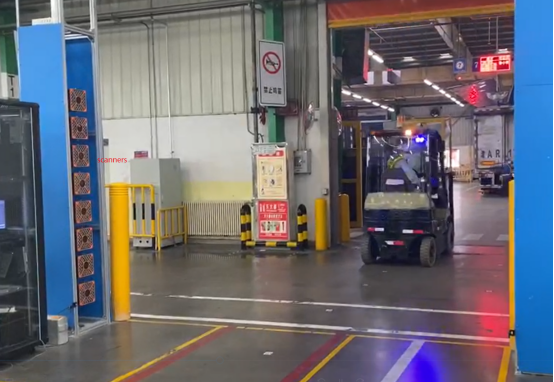
• Optimized Channel Door Layout: The standard configuration adopts 5 cameras installed on the left and right sides of the channel door respectively, with a supporting depth of field of 200mm. The red marked area is the effective code reading area, allowing a maximum offset of 100mm outward for 1200mm-specification cargo, and the near-end effective coverage height reaches 1575mm, which covers most standard logistics cargo specifications.
3. Main Recommended Hardware Introduction
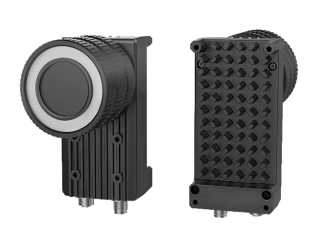
3.1 ED6200M Special Intelligent Code Reading Camera for Channel/Logistics Door
3.1.1 Functional Features
• High-performance Adaptation: Equipped with high frame rate performance, it perfectly adapts to high-speed moving code reading scenarios of logistics channel doors.
• Wide-field Recognition: Adopts horizontal high-resolution design to meet the large-field identification demands of bulk cargo in the logistics industry.
• Flexible Collocation: Supports diversified matching of lenses and light sources, which can be adjusted according to cargo size, barcode position and working distance.
• Industrial Durability: Reaches IP67 industrial protection level, resistant to dust, water splash and extreme temperature changes, suitable for harsh industrial and warehouse environments.
• Strong Compatibility: Supports full types of mainstream 1D and 2D barcodes in the industry, including common surface labels of cartons and EU boxes.
• Product image
3.2 Infrared Enhanced Code Reading Light Source for Logistics Door
3.2.1 Functional Features
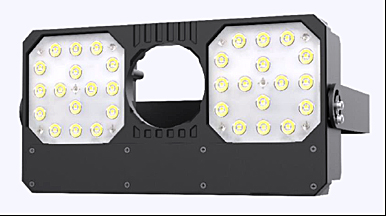
• Integrated Control: Specially developed for intelligent code readers, the light source can be directly controlled by the code reading camera without additional control accessories.
• Multi-mode Operation: Supports three working modes including constant brightness, stroboscopic and trigger brightness; the brightness is divided into 3 adjustable gears to adapt to different light environments.
• High-efficiency Lighting: Concentrated light distribution and high luminous efficiency; the novel structural design simplifies on-site installation steps.
• Industrial-grade Design: Adopts high-light-transmittance acrylic panel, featuring high temperature resistance and low brightness loss; optimized structure and drive design to extend service life.
• Green Environmental Protection: The product contains no harmful heavy metals such as lead and mercury, meeting international industrial environmental protection standards.
3.2.2 Core Technical Parameters
Parameter Item | Specific Specification |
Light Source Type | 32 LED beads with constant brightness |
Uniformity | 0.5 |
Central Illuminance | 0.03 mW/mm² @ 1500mm working distance |
Radiant Flux | Approx. 30W |
Input Voltage | 24VDC |
Optimal Projection Distance | 1.5m |
• Product image
4. Typical Project Demand Specifications
This solution takes the 20-megapixel intelligent code reading door as the standard configuration, and the detailed demand parameters for standardized warehouse scenarios are as follows:
Demand Item | Parameter Standard |
Required Field of View Height | 1500mm |
Channel Door Overall Dimension | Scheme 1: L1600*W1200*H1500mm; Scheme 2: L1200*W800*H1500mm |
Applicable Cargo Type | EU standard boxes, ordinary cartons |
Depth of Field Requirement | 400mm |
Single Cargo Barcode Quantity | 1 piece |
Surface Label Size | 100mm×70mm |
Barcode External Dimension | 18mm×18mm |
Minimum Barcode Unit Width | Approx. 15mil |
Barcode Pasting Surface | Four sides of cargo (optional identification) |
Cargo Transportation Mode | AGV automatic handling, manual forklift handling |
5. Detailed Introduction to Application Schemes
5.1 Single-camera Scanning Scheme (For Goods Inbound & Outbound Scenario)
5.1.1 Scanner Configuration
• Camera Model: ED6200M-00C-NNG
• Lens Model: ED3528M-12MP (35mm focal length for goods receiving)
• Light Source Model: MV-LB-270-140-4030WL-A
• Working Distance: 1462mm
• Installation Mode: The long side of the camera corresponds to the height direction of the cargo, and the short side corresponds to the cargo movement direction
5.1.2 Scheme Performance
• Effective Depth of Field Coverage: 400mm
• Near-end Field of View: 400mm*265mm
• Far-end Field of View: 545mm*365mm
• Note: Imaging parameters can be fine-tuned according to actual on-site environmental conditions
5.2 Multi-Scanners Unilateral Scheme (For Goods Inbound & Outbound Scenario)
5.2.1 Scanner Configuration
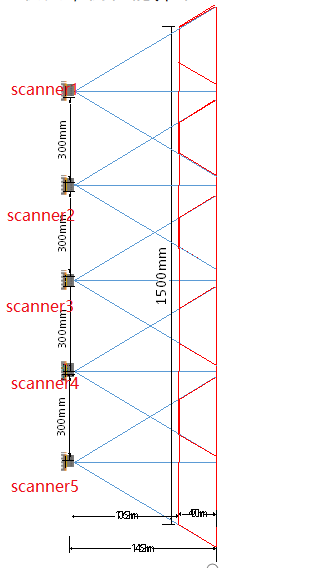
• Camera & Quantity: ED6200M-00C-NNG ×5
• Lens & Quantity: ED3528M-12MP ×5
• Light Source & Quantity: MV-LB-270-140-4030WL-A ×5
• Auxiliary Equipment: Industrial PC ×1,
• LED Display Board ×1 ,
• Working Distance: 1200mm - 1400mm
• Camera Spacing: 360mm
• Installation Mode: The long side of the camera corresponds to the horizontal direction, and the short side corresponds to the vertical direction
• Scanners Schematic Diagram
• Scanners Real Product Image
• 
5.2.2 Scheme Performance
• Effective Depth of Field Coverage: 400mm
• Near-end Super Wide Field of View: 1590mm*265mm
• Note: All imaging parameters support on-site dynamic debugging
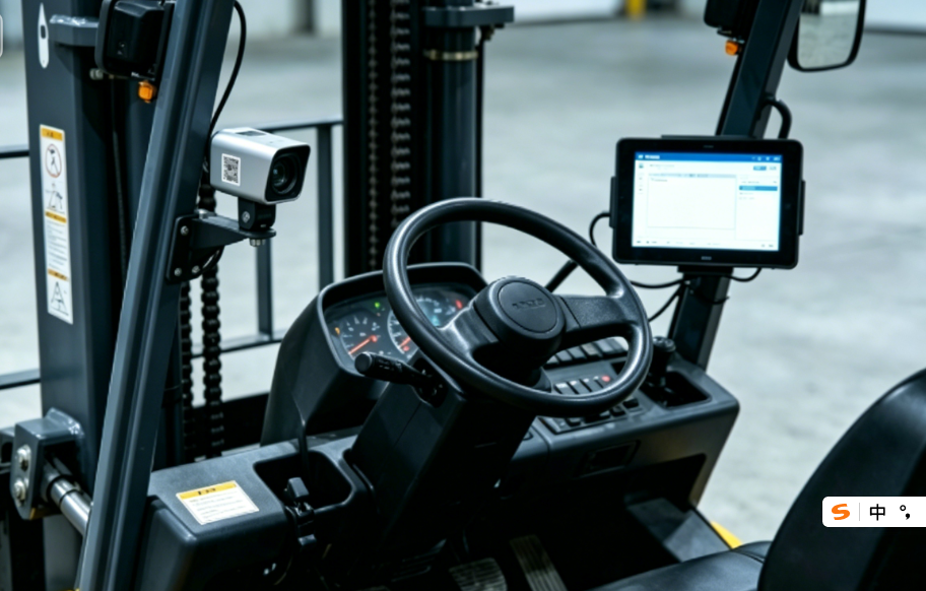
5.3 Forklift Retrofit Scheme (Small-batch Code Reading)
Aiming at small-batch and scattered cargo operation scenarios, we provide a dedicated forklift-mounted code reading solution with lower cost and simpler deployment:
• Code Reader Model: ED3900
• Supporting Light Source: MV-LB-270-140-4030WL-A
• Effective Working Distance: 500mm - 1400mm
• Terminal Equipment: P1000 10-inch Tablet (4GB+64GB), used for docking ERE system and realizing data real-time interaction
6. Software System Function Description
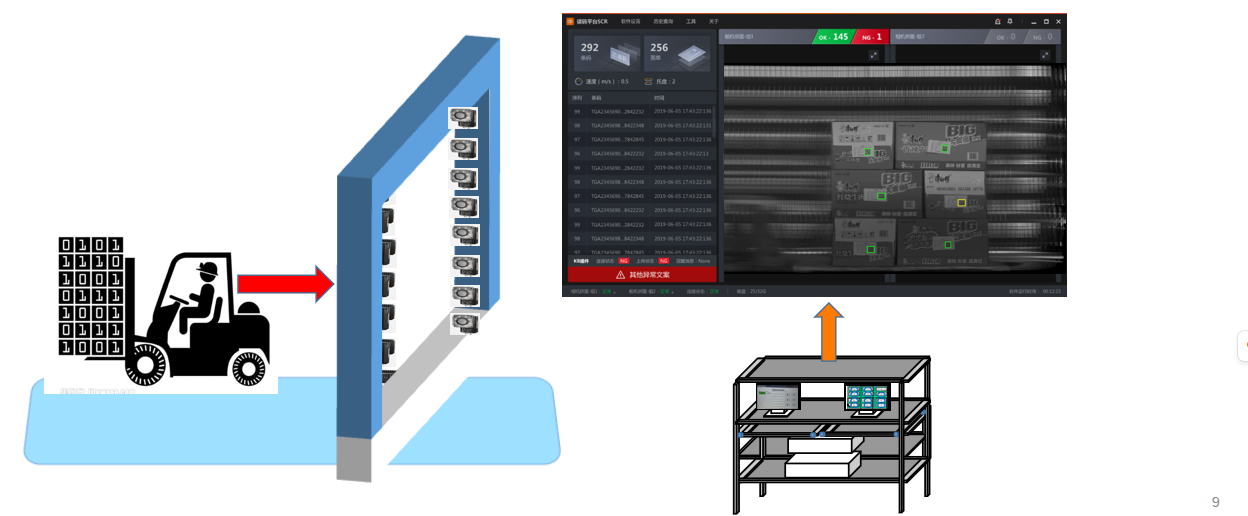
The supporting visual management software realizes visualized and digitalized full-process management of cargo code reading. When AGVs or forklifts pass through the code reading channel door, the system triggers the camera group to take photos automatically. The visual platform synthesizes multiple collected images into a complete panoramic picture, and marks successfully identified barcodes with green frames.
The core data functions are as follows:
1. Data Statistics: Automatically count the number of identified barcodes, and compare it with the task data of the upper management system;
2. Abnormal Alarm: Trigger sound and light alarm when the actual identified quantity does not match the system data;
3. Position Traceability: Assist operators to quickly locate unidentified cargo areas through panoramic synthesized images;
4. Data Storage & Upload: Automatically store identification records and original images, and synchronize valid data to the upper-level logistics management system.
7. Business Operation Process
1. Task Entry: The manager inputs the delivery order and cargo basic information into the system in advance to generate a corresponding code reading task;
2. Automatic Identification: AGVs or manual forklifts carry cargo through the code reading door, and the camera group completes barcode collection and identification;
3. Result Judgment: The system automatically judges whether all barcodes are identified completely; alarms for missing reading and abnormal identification;
4. Manual Remediation: For abnormal cargo, the operator uses PDA or supporting tablet equipment to complete manual supplementary scanning and entry;
5. Task Completion: After the barcode quantity and cargo information are verified to be correct, the system automatically uploads all data, closes the corresponding delivery order task, and ends the receiving process.
8. Risk Analysis & Optimization Measures
8.1 Potential Identification Risks
• Cargo placement deviation: Excessive offset beyond the effective code reading field of view will lead to identification failure;
• Barcode surface defects: Film covering, surface reflection, damage, wrinkles, shielding and needle breakage of barcodes will affect recognition accuracy;
• Specification limitation: The standard scheme is applicable to barcodes with a unit width of 12.6mil-19.5mil; ultra-small specifications need customized secondary design;
• Scenario Restrictions: The scheme is based on a single type of cargo surface label; multiple types of labels will increase the difficulty of algorithm identification;
• Data Interface: The detailed data docking protocol and personalized business process need to be confirmed through secondary communication with customers.
8.2 Risk Optimization Measures
• Equip auxiliary PDA/tablet terminals for all operation scenarios to support rapid manual supplementary scanning of unidentified barcodes;
• Optimize the algorithm anti-reflection model, and match adaptive infrared light sources to reduce the impact of light reflection on identification;
• Provide personalized hardware layout and algorithm parameter adjustment services for special barcode specifications and multi-label scenarios;
• Support multi-protocol data docking, and reserve open interfaces to adapt to mainstream warehouse management systems in the market.
9. Conclusion
EDOO’s AI warehouse and logistics code reading solution covers multiple deployment forms such as fixed channel doors and forklift retrofits, which can fully meet the code reading demands of bulk batch operation and small-batch scattered operation in logistics warehouses. Relying on industrial-grade vision hardware and self-developed intelligent identification algorithm, the system solves various pain points in traditional manual code reading. Meanwhile, the solution has strong scalability and compatibility, which can be customized according to customer on-site scenarios, helping enterprises reduce labor costs, improve cargo receiving and handling efficiency, and realize the intelligent upgrading of warehouse logistics business.
Brand Slogan: EDOO, EASY TO DO, Create a Smart Logistics Future Together
About

Products
Solutions
Support
News