+86-18050089566(WhatsApp/wechat)
+86-18050089566(WhatsApp/wechat)

Time:2026-09-17 Views:865
A bar code scanner for supermarket needs to do more than simply read product codes. In busy retail environments, slow scanning, connection problems, poor code recognition, and complicated installation can delay checkout and inventory work. You need a scanner that handles common 1D product barcodes while also supporting 2D codes and QR codes used for coupons, electronic vouchers, and mobile payments.
The EDOO H41-10 addresses these requirements with USB plug and play connectivity, 300 scans per second, a 640H x 480V image sensor, and support for both 1D and 2D symbologies. EDOO develops barcode scanning devices for retail, logistics, healthcare, warehousing, and other professional applications, supported by its R&D capabilities and international product certifications.
Supermarket operators typically handle several scanning tasks during a single shift. These include product checkout, price verification, inventory counting, membership activities, promotional coupons, and QR-based services.
A suitable bar code scanner for supermarket applications should therefore provide:
Fast scanning for repetitive checkout operations
Reliable 1D barcode recognition for packaged goods
2D and QR code support for digital vouchers and coupons
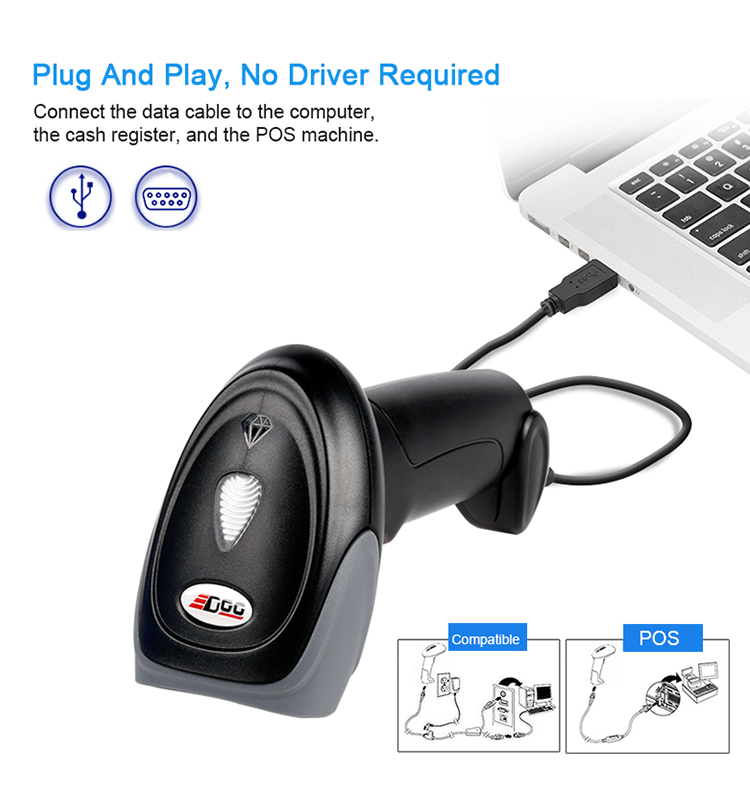
Simple USB connection for quick deployment
Comfortable handheld operation
Compatibility with retail and inventory management systems
Flexible interfaces for different equipment configurations
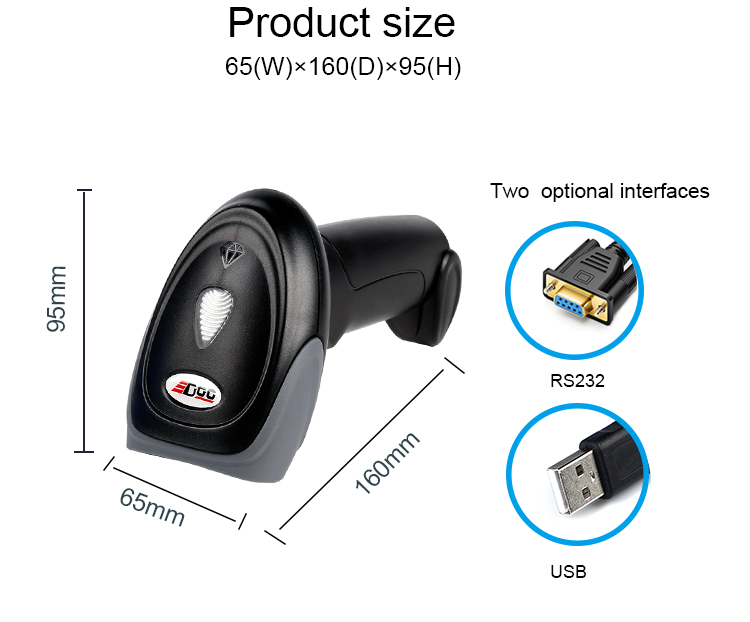
The H41-10 supports USB HID-KBW, CDC, and HID-POS modes. It also supports RS232 through customization, giving you more flexibility when integrating the scanner into existing retail equipment.
The H41-10 combines a handheld design with practical scanning performance. Its image sensor provides 640H x 480V resolution, while white LED illumination and a 625nm red LED aiming system help you position the scanner accurately.
For common retail applications, the scanner supports Code 128, EAN-13, EAN-8, Code 39, UPC-A, UPC-E, Codabar, Interleaved 2 of 5, ITF-6, ITF-14, ISBN, Code 93, UCC/EAN-128, GS1 DataBar, and other 1D formats.
It also reads PDF417, Data Matrix, QR Code, and Micro QR Code.
| Feature | EDOO H41-10 |
|---|---|
| Scanning capability | 1D + 2D + QR |
| Scan speed | 300 scans/s |
| Image sensor | 640H x 480V |
| Reading precision | ≥3 mil Code 128 |
| Interface | USB, COM, PS/2 |
| USB connection | Plug and play |
| USB modes | HID-KBW, CDC, HID-POS |
| RS232 | Available with customization |
| Dimensions | 160 x 95 x 65 mm |
| Weight | 180 g including USB cable |
| Operating temperature | -20°C to 60°C |
| Storage temperature | -40°C to +70°C |
| Relative humidity | 5% to 95%, non-condensing |
| Certifications | FCC Part 15 Class B, CE EMC Class B |
These specifications make the H41-10 suitable for supermarket checkout counters, inventory stations, retail service desks, and other locations where operators need frequent barcode scanning.
The plug and play design can simplify installation, especially when you need to deploy scanners across multiple checkout or inventory stations.
Connect the scanner to the computer, POS system, or compatible host through USB.
Allow the system to recognize the device using the supported USB interface mode.
Position the barcode within the scanner's effective reading range.
Scan the product code using the red LED aiming guide.
Transfer the decoded information to your POS, inventory, or data management software.
Test different barcode types before putting the scanner into regular operation.
This setup can reduce installation complexity and help your staff start using the device with minimal configuration.
A supermarket barcode scanner can support multiple workflows beyond checkout. For example, cashiers can scan EAN-13 or UPC codes during payment, while inventory teams can use the same device to record products during stock checks.
The H41-10 also supports QR codes and PDF417, which can be useful for digital coupons, electronic vouchers, promotional campaigns, and other 2D-code applications.
Typical applications include:
Supermarket checkout counters
Retail stores
Inventory management
Warehouse stock checking
Product receiving
Digital coupon redemption
QR code payment-related workflows
O2O retail services
Hospital and healthcare data collection
For inventory operations, the scanner's support for common 1D and 2D formats allows you to work with different labels without deploying separate scanning devices for every code type.
EDOO focuses on IoT devices and barcode scanning technology, with a product portfolio covering handheld scanners, desktop scanners, fixed-mount scanners, wearable scanners, barcode scan engines, industrial PDAs, tablets, printers, and related solutions.
The company states that its technical team holds dozens of national patents and develops barcode scanning products using its dual-CPU architecture barcode scanning technology.
For buyers evaluating suppliers, product certification is also an important consideration. EDOO provides certification documentation including FCC Part 15 Class B and CE EMC Class B for relevant barcode scanner products. Its qualification portfolio also includes RoHS documentation and CE certification for selected barcode scanner modules and PDA terminals.
These credentials give you additional technical and compliance information to consider during supplier evaluation.
Different retail environments require different scanner designs. The H41-10 is particularly relevant when you want a handheld device with wired connectivity.
| Scanner Type | Best For | Main Consideration |
|---|---|---|
| H41-10 handheld scanner | Supermarkets and retail | USB, 1D, 2D and QR |
| Fixed mount scanner | Automated stations | Requires fixed installation |
| Wireless scanner | Mobile inventory work | Requires wireless and battery management |
| Desktop scanner | Countertop scanning | Less flexible for handheld operation |
| Scan engine | OEM equipment | Requires integration into a host device |
If your priority is straightforward deployment at checkout or inventory stations, a USB handheld model can offer a practical balance between flexibility and installation simplicity.
Before purchasing a bar code scanner for supermarket operations, evaluate your actual workflow rather than focusing only on scan speed.
Consider these factors:
Barcode compatibility: Confirm support for the 1D, 2D, and QR formats your business uses.
Connection method: USB plug and play can simplify deployment.
Scanning environment: Check operating temperature and humidity requirements.
Integration: Verify USB modes and whether RS232 customization is available.
Ergonomics: A 180 g handheld scanner can be practical for repetitive scanning.
Supplier support: Check OEM, ODM, technical support, and after-sales capabilities.
Compliance: Review applicable CE, FCC, RoHS, or other certification documents.
EDOO also provides OEM and ODM services, allowing businesses with specific hardware or integration requirements to discuss customized solutions directly with the supplier.
Yes. The H41-10 supports 1D and 2D barcode scanning, including QR Code, Micro QR Code, Data Matrix, and PDF417.
Yes. Its USB plug and play connection, 300 scans per second, handheld design, and support for common retail barcode formats make it suitable for supermarket checkout and inventory applications.
Yes. The scanner supports USB interfaces as standard and RS232 through customization. You can discuss the required interface configuration with EDOO before purchasing.
Choosing the right bar code scanner for supermarket operations can improve checkout efficiency, inventory accuracy, and digital code handling. With 300 scans per second, USB plug and play connectivity, 1D, 2D and QR support, a 180 g handheld design, and FCC and CE EMC certifications, the EDOO H41-10 provides a practical option for retail and inventory applications.
If you need a supermarket scanner for checkout, stock management, QR code applications, or customized retail equipment, contact EDOO to confirm compatibility, interface requirements, certification documents, and OEM or ODM options before placing your order.
ABOUT US

PRODUCT
Solution
SERVICES
NEWS