+86-18050089566(WhatsApp/wechat)
+86-18050089566(WhatsApp/wechat)


Time:2026-10-06 Views:0
Buy one handheld barcode scanner and you are buying a demo. Buy sixty and you are writing a document. The demonstration unit is fresh, paired, charged, on a bench under office light reading a label printed this morning — and the quotation you receive describes that device, not the one that will live in a glove on a pick cart at hour seven of a three-shift week. A fleet specification exists to close that gap: to convert observed conditions in your building into line items a supplier has to answer in writing, and to price what happens after the first quarter.
The scope here is a set of ten to two hundred portable readers used by multiple crews across a warehouse, a store network or a production floor — the handheld scanner class, whether they report over a cable, a radio link or a charge cradle. It assumes the form-factor question is already settled; if your reads all happen at one stationary position with both hands on the goods, that is a fixed-mount or presentation decision and it is argued on labour seconds rather than on this document. What follows covers decode performance expressed correctly, duty, range, connectivity generation, the accessories that actually fail, battery architecture, fleet configuration, and a three-year cost shape.
Every line item below is meaningless without four numbers from your own operation: scans per operator per shift, the smallest symbol you expect to read and the distance it is read at, the share of time the device is away from a charger, and the temperature and racking environment between device and host. Take them by timing two shifts, not by guessing in a meeting. Two quotes for identical-looking devices become comparable only against that sheet — which is also the sheet that tells you whether you are buying readers at all or a mobile computer with a reader built in.
Symbol density. Barcodes are specified by X-dimension (module width), in mils or tenths of a millimetre. Measure the narrowest symbol you actually print or receive — the shelf-edge label, the vendor's inner-carton mark, the direct-marked part — and specify the reader against that density at the distances you work at, allowing for a label that has faded or been run over. "Reads small barcodes" is not a requirement; "reads the 5 mil Code 128 on our shelf labels from 10 cm to 150 cm" is.
Print quality as a graded deck, not a boast. Print-quality grading is defined by ISO/IEC 15416 for linear symbols and ISO/IEC 15415 for area symbols, where the worst measured parameter sets the grade, and ISO/IEC 15426 covers the verifier doing the measuring. Use them to describe your test artefacts, never as a prediction: a grade is a property of a label measured through a defined aperture and illuminant, which is a different optical system from a reader behind a protective window in your aisle. So make the RFQ line a signed acceptance test — a deck of your own worst labels, a minimum first-read rate per cell, a maximum 95th-percentile time-to-read, measured on shipping units — and see the deck-building method under the Solution index.
Output format, because that is where integration breaks. Specify the payload, not just the read. For GS1 keys, state whether application identifiers are de-composed by the reader or delivered raw to the host; whether FNC1 and the group separator are emitted, converted or stripped; whether symbology identifier prefixes such as ]C1, ]d2 or ]Q3 are on or off; and exactly which suffix terminates a scan. A reader that silently strips separators turns a composite GS1-128 into an ambiguous digit string in the host, and that is a data-integrity defect nobody traces back to hardware. "Supports all 1D and 2D symbologies" is a weak answer, and it is what most of the scan engine class gives.
A reliability figure is measured under conditions the manufacturer chose, and decode quality is usually not among the quantities it describes; that methodology is a separate subject and is not re-derived here. What matters at fleet scale is the arithmetic you can do yourself: trigger pulls per shift, times shifts per day, times the retry multiplier your first-read rate generates. That number sets the device class and tells you which parts you will replace — in practice the trigger switch and its flex tail, the charging contacts, the battery, the window cover and the case seams. Put the expected scan volume in the RFQ and ask which of those is a serviceable item with a priced spare.
Range is a trade, not a level. A depth of field deep enough to find a pallet label across an aisle costs close-range resolution, and a long-range optics choice that never comes back to the 10 cm case mark shows up as operators leaning over a conveyor to aim. Specify an envelope for your two worst cases — the closest small symbol and the furthest acceptable one — and require both measured on the same unit. Note the honest non-hardware fix too: a code that only reads from a ladder is usually a label-placement problem, and fixing placement is cheaper than buying optics.
like an input device with no host software but behave differently on wake latency and on hosts that drop bonds. Ask for the reconnection policy, whether a unit can be locked to one host, and how you tell which host it is bound to — a reader that joins the neighbouring operator's session creates a data-integrity failure that looks like a warehouse error.
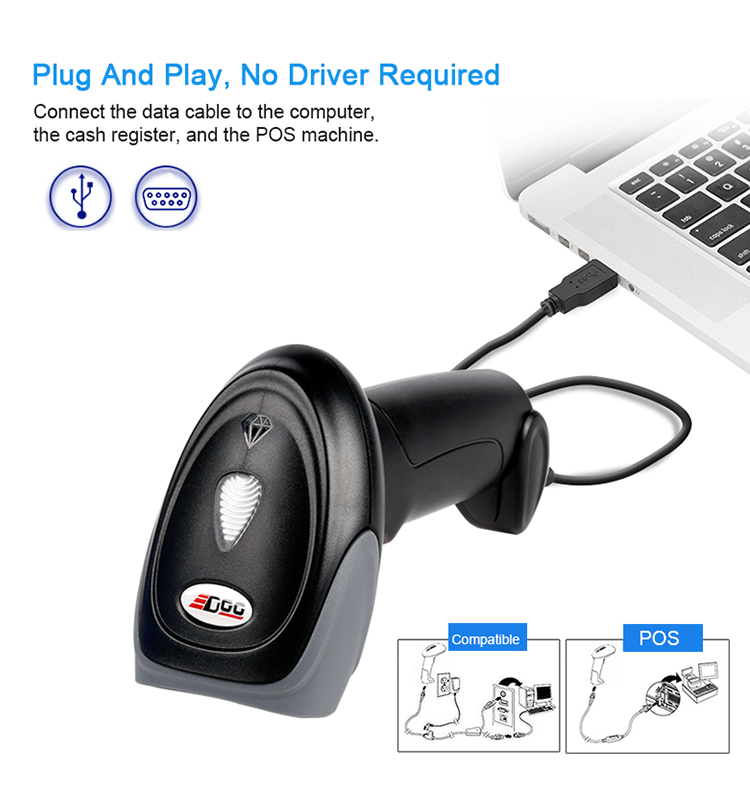
"long range" figure is not a racking figure. EDOO lists W43 as a handheld with 150 m transmission and a charging base bracket, and W41-10 as a portable 2.4G/Wi-Fi/Bluetooth warehouse reader — both are the proprietary 2.4 GHz link class rather than a Bluetooth distance claim, so require range measured through your racking, on the product documentation of the exact SKU.
aisle twelve loses TCP sessions unless the network and the client both support fast roaming (802.11r with k/v assistance). Do not specify a Wi-Fi reader before a survey of the actual layout: a Bluetooth reader plus a docked or cabled host often costs less than the access points a Wi-Fi fleet implies.
Cradles and their pogo contacts wear and oxidise: a unit that will not seat charges intermittently, gets unplugged, and ends the shift dead. Holsters and hand straps tear at the stitching and lose their swivels, and on a high-reach fleet the strap is also what stops a drop. Trigger styluses, spare cables, window protectors, spare packs and the multi-bay charger are all consumables. Then the quiet one: charge positions per operator is a fleet-design decision, not an afterthought, and a shortfall shows up as a queue at the one spare cradle in the break room. Require named part numbers, per-unit-per-year replacement prices and minimum stock commitments in the contract — that is where an ODM agreement earns its keep, because the accessory list can be fixed at order rather than renegotiated at failure.
Three shapes: a fixed internal cell with cradle top-ups; removable spare packs plus an external multi-bay charger; or a charging cartridge handle carrying extra capacity in the grip. Packs per operator is shift hours divided by measured endurance, rounded up, plus a service margin — and endurance must be measured at your duty cycle in your temperature, because a cold store drains faster and accepts almost no charge while the device is cold. Cartridge handles buy endurance with mass and add a shared-asset problem. The metric that predicts operator anger is recharge events per shift: one is invisible, three is a queue at the locker, each costing dozens of picks.
The IEC 60529 digits, the drop height and the MIL-STD-810 wording are decoded in the site's ingress and drop-rating guide; put the digits and the report reference in the RFQ and move on. Spend the remaining attention on serviceability — window, contacts, packs, strap anchors, case seams — because those decide availability in year three more often than the ratings do.
Specify, in writing: a machine-readable configuration object or command set capturing every setting (symbology enables, prefixes, suffixes, AI parsing, beep, vibrate, timeout, wake-on-motion, pairing policy); a bulk application route — cradle, cable, memory card, PC tool or management console — that works without store Wi-Fi; the ability to read a unit's configuration back, so drift is detectable; and behaviour across a firmware update, because an update can quietly reset symbology enables and terminators. Require the baseline to be checksummed and re-appliable after a factory reset. "We set it up before shipping" is a weak answer: it describes an act, not a reproducible state.
| Bucket over three years | Illustrative share of total cost | What moves it |
|---|---|---|
| Reader hardware at purchase price | ~40% | Unit count plus a 3-5% hot-spare ratio |
| Accessories and wear parts (cradles, cables, straps, holsters, window protectors) | ~15-20% | Replacement interval per unit per year |
| Power (packs, cartridges, multi-bay chargers, lockers) | ~10% | Packs per operator and charge positions |
| Downtime: re-keyed data, degraded throughput while a unit is away | ~20-25% | First-read rate and repair-loop length |
| Configuration, support labour, re-imaging, RMA freight | ~10% | Whether config is one command or one visit |
These percentages are a planning shape for a fleet deployment, not a quotation, and no vendor figures are implied. The point of the shape is that purchase price is under half of the three-year number, so a cheaper reader that doubles your accessory burn or your re-keying is not cheaper. The downtime row is the one worth arguing about, because it is dominated by first-read rate on your own labels — which is why the graded acceptance test above is the highest-leverage sentence in your RFQ.
| Line item | Write it this way | Weak answer |
|---|---|---|
| Decode performance | Smallest X-dimension in mils plus the read distances, per named label type, with a signed deck and a minimum first-read rate | "Reads all 1D and 2D barcodes" |
| Data format | AI handling, separator handling, symbology identifiers, prefix/suffix table, one worked example per code type | "Standard output, can be adjusted" |
| Duty | Scans per shift per operator, shifts per day, retry multiplier | A lone MTBF hours figure with no conditions |
| Range | Envelope for the closest and furthest real case, same unit | "Long range" |
| Wireless | Profile, radio class, pairing lock, range measured through racking | "Bluetooth 5.0, up to 100 m" |
| Power | Endurance measured at your duty cycle and temperature; packs per operator; charge positions | Battery capacity in mAh, nothing else |
| Accessories | Named part numbers, unit prices, replacement interval, stock commitment | An unplotted accessories flyer |
| Configuration | Machine-readable config, bulk apply route, read-back, survives firmware update | "We configure before shipment" |
| Service | Serviceable parts list, spare-part horizon in years, RMA turnaround and freight | "Warranty one year" |
| Proof | Pilot units in your building, on your labels, for the shift pattern, with exit criteria | A bench demo in the supplier's office |
Settle the pilot terms — units, weeks, exit criteria, who pays return freight — before the specification freezes, through the contact team.
How many handheld barcode scanners should a fleet specification include beyond the operators? Plan working units plus a hot-spare ratio of roughly three to five percent, with consumables — spare packs, cradles, cables, protectors — counted separately, because a spare pool sized against purchase price rather than failure rate is why operators end up sharing one unit.
How do I specify barcode decode performance in an RFQ without quoting a datasheet? State the smallest symbol density you need to read, in mils, together with the read distances and the exact label types, then require a signed acceptance test on your own graded label deck with a minimum first-read rate and a maximum 95th-percentile time-to-read per cell; ISO/IEC 15416 and 15415 grades describe the labels, not the reader, so they belong in the deck rather than in the requirement.
What is the biggest hidden cost in a handheld scanner fleet? Accessories and downtime together usually outweigh the readers: cradles, contacts, straps, holsters and window protectors are consumables with a replacement interval, and every missed read converts into re-keyed data or a unit sitting in a break room, which no purchase-price comparison captures.
Should a handheld scanner fleet use Bluetooth, a 2.4 GHz link, or Wi-Fi? Choose by the environment: Bluetooth Classic presents a serial port and needs host software while BLE HID pairs without it, a proprietary 2.4 GHz link usually buys range and robustness through racking, and Wi-Fi only makes sense where an RF survey supports roaming behaviour — so specify the pairing and reconnection policy and require range measured in your own aisles.
Handheld barcode scanners · Android PDA and POS terminals · All EDOO solutions · Barcode scan engines · Product documentation and SDKs · ODM / OEM services · Contact EDOO · Fixed mount barcode scanners · W41-10 product page
ABOUT US

PRODUCT
Solution
SERVICES
NEWS