+86-18050089566(WhatsApp/wechat)


Time:2026-10-17 Views:0
A hands-free barcode scanner is a reader that needs no hand to hold, aim or squeeze: it is either worn — ring, glove or wrist — or mounted, so the label is brought to it. EDOO's answer is chosen by two questions: where the worker's hands are during the read, and where the label sits.
In short:
The finger-worn layer — the pick-cycle case, trigger modes, the optics penalty of a body worn on a digit, and pilot design — belongs to the parent article, Wearable barcode scanner: what hands-free picking actually changes, and is not re-derived here. This article widens to the whole hands-free class, including the readers mounted rather than worn.
The phrase describes a mounting and a starting method, not a decoding engine. Two tests decide membership. First, the hand test: at the moment of the read, is a hand occupied holding and pointing the reader? Second, the actuation test: does the read need a worker to aim it or press a trigger? A unit that passes both is hands-free whether it is worn on a finger, strapped to a wrist, screwed to a conveyor frame or embedded behind a checkout aperture.
Three words carry the rest of the vocabulary. Trigger-free means no physical button starts a read — the device reads on approach, on motion or continuously. Presentation mode means the reader stays put and the worker presents the label to it, which is how a desktop scanner and a fixed-mount reader both behave. A lanyard or holster is not hands-free: a strapped scanner still has to be lifted and aimed, and a cradle holding a pistol grip is a storage decision, not a reading one.
| Class | Where the reader sits | What the worker does at the read | What this means for your deployment |
|---|---|---|---|
| Finger-worn ring | Optics, decoder, cell and radio on one digit | Keeps both hands on the load and reads near the fingertip | Choose it for dense bin, tote and item labels; specify mode set and confirmation channel |
| Glove or back-of-hand | Spread across the hand; EDOO's AI1580 carries its own Android 14.0 host at 99 g | Reads while gloved, without a separate phone in the hand | Choose it where gloves are permanent; ask whether the unit is a peripheral or the computer |
| Wrist-worn | Strap at the wrist, read by a flick or a top-facing window | Flicks or rotates the wrist to present | EDOO publishes no wrist body, so source the mount and prove read direction on your labels |
| Desktop or presentation scanner | On a counter, a stand or a slot-style scan box | Presents the label or the screen to the reader | Put it where the transaction stops: checkout, packing bench, service desk |
| In-counter or self-service module | Embedded behind an aperture the customer uses | Nothing; the customer presents | Specify aperture geometry, mounting depth and interface, not handheld ergonomics |
| Fixed-mount reader at a station or conveyor | Bolted and aimed at one plane the label crosses | Nothing; the label arrives | Buy it for code density and web or belt speed, then prove decode on your own labels |
| Embedded scan engine | Inside a terminal, kiosk or machine the process owns | Nothing at all | Decide who owns the decode firmware, the interface and the SDK (Software Development Kit) |
Rows one to three are wearable; rows four to seven are mounted. The dividing line is not mass or price — it is whether the reader travels with the person or stays with the place.
Read the label position first, then the mount. Bin faces and item labels sit within arm's reach at awkward heights, which is the near-range case for a finger or glove mount. Case and tote labels pass at waist height on a bench or in a tote, which suits a back-of-hand mount or a presentation reader on the bench. Pallet labels are read across an aisle or from a seat, at a reach no worn body provides; that is a long-range handheld or vehicle-mounted job, and the parent article holds the reasons. Checkout and counter labels are presented by a cashier or a customer to a fixed aperture, which is a desktop or in-counter decision. Conveyor and station labels move, sometimes fast, and are read by a fixed-mount reader aimed at the plane they cross; decoding small 2D symbols at line speed is the conveyor article's topic. Machine and document labels — a passport page, a voucher on a screen — belong to an embedded engine, where no person is available to aim.
Write that matrix before the device order. Choosing one wearable class for a whole building is how a hands-free project fails to clear its own labels — a class-selection error, not a scanner defect.
When the transaction stops at a place. A presentation reader is a stationary imager with a wide field of view, aimed so a label or a phone screen passes through it, and its host is the till or bench software rather than a person. EDOO's desktop scanner range covers that job, and the D46's published title names the settings — supermarket, pay and inventory — where the reader is part of the furniture. Slot-style scan boxes are the same idea in a narrower window: the item is drawn through an aperture, so aperture geometry rather than aiming decides what gets read.
The hybrid is worth naming, because buyers often mean it when they say hands-free: a handheld that docks into a stand is a presentation reader at the bench and a carried reader in the aisle. EDOO's W50 descriptor states "USB 2.4G Wireless QR Reader with Stand for Logistics & Manufacturing" — the same decode, two mounting decisions, one asset to charge and track. Choose the docked handheld when a station is used intermittently, a dedicated desktop unit when a queue forms.
When the label arrives without a person attached to it. A fixed-mount reader is aimed once, at a bracket, and its design question is the plane the symbol crosses: EDOO's fixed-mount range carries industrial readers for that pattern, including the ED5000, titled an "IP67 Industrial Fixed Mount Barcode Scanner for Fast Moving Codes on Conveyor Belt", and the ED3000, titled for fast-moving Data Matrix. IP67 under IEC 60529 means dust-tight and rated against temporary immersion, which is the wash-down and outdoor-station context where a worn device has no role: nobody stands at the belt to wear anything.
Two decision rules are settled elsewhere and not re-argued here — whether a position belongs to a fixed reader or a handheld is the fixed-mount versus handheld decision rule, and line-speed decoding is the conveyor barcode reader material. What matters for hands-free selection is the boundary: fixed-mount readers are hands-free for the process, not for the person, and a station that mixes the two needs them to confirm different things — the frame reader proves the item passed, the worn reader proves the worker chose it.
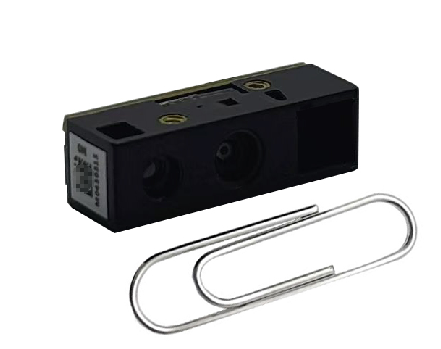
The smallest hands-free reader is not a product on a shelf but a module inside something else. EDOO's scan engine range and scanner module range are imaging engines built into terminals, kiosks, vending and payment machines and self-service checkouts, and the MF61-M descriptor states the use plainly: "2D Hands-Free Barcode Scanner Module for Supermarket And Self-service Checkout". In that build no operator stands at the reader — the machine's firmware opens the aperture, the engine decodes, and the host receives characters over the interface the designer chose.
Three consequences follow. Specification moves from ergonomics to integration: window geometry, the working distance the module states, the interface, and who owns the firmware and symbology set. The decode is judged on the label and the aperture, not on how anything is held. And the module inherits the enclosure's dust, light and cleaning regime, so that rating becomes the host product's question. Where a worn reader fails, the same silicon mounted in the machine usually succeeds — which is why a station design often ends with one wearable per person and one engine per place.
Transport is not mount, and buyers mix them up. Worn readers in this family move data as HID (Human Interface Device), which drops characters into whichever field has focus, as SPP (Serial Port Profile), a serial pipe to an application, as BLE GATT (Generic Attribute Table), which usually requires a vendor SDK, or through a 2.4G receiver, a dongle paired to the device rather than to the host's Bluetooth stack. EDOO's R41-21 states all three Bluetooth modes plus a 2.4G receiver, and the AI1580 removes the host question by carrying its own Android 14.0 and Wi-Fi. Mounted readers are dominated by cable classes: a desktop unit goes to the till over USB or RS-232, and a fixed-mount reader is cabled to the machine it watches. Which connector or radio suits your host is the scanner connection classes question, answered there.
On the order, four things change when you buy by class. You specify mount and read direction per position, not one device per site. You state the confirmation channel each class needs — sound and vibration on a worn unit, a screen prompt at a counter, a signal light at a station. You name who buffers reads when the link drops, since store-and-forward is a device-memory spec only some pages quantify. And you set the integration owner: SDK for a GATT wearable or an embedded engine, focus-field wedge for a presentation reader. EDOO is a Shenzhen OEM and ODM manufacturer whose published production terms run from 100 units, with 15-day samples and 30-day mass production, and its products carry CE, FCC and RoHS marks.
Model descriptors and parameter rows above are as published on edoo-iot.com, October 2026; confirm every figure against the datasheet at order time.
What makes a barcode scanner hands-free? Two things: no hand holds or aims the reader at the moment of the read, and no trigger squeeze is needed to start it. A finger-worn ring passes by traveling with the finger, a desktop presentation scanner by staying on the counter while the label is brought to it, and a fixed-mount or embedded reader by having the process deliver the label.
Is a hands-free barcode scanner with Bluetooth always a wearable? No. Bluetooth is a transport, not a mount. Wearable ring and glove readers commonly use Bluetooth or a 2.4G receiver, while most desktop and fixed-mount readers are wired to the till or the machine, and several worn units can also charge and pass data over a cable. Specify the mount first, then the mode set the host accepts.
Which hands-free class fits a supermarket checkout or self-service kiosk? A mounted one: a presentation reader on the counter or an embedded module behind the aperture. EDOO's desktop range covers counter use, and the MF61-M is published as a "2D Hands-Free Barcode Scanner Module for Supermarket And Self-service Checkout". A worn reader belongs where hands carry the load, not where a customer presents an item.
Do hands-free scanners replace a handheld fleet? No. Worn and mounted classes delete the hold-and-aim step at the positions they cover, while reach across an aisle, ad-hoc counts and exception checks stay with a handheld. The fixed-versus-handheld choice is decided by the fixed-mount versus handheld decision rule and the pick-cycle case by the wearable picking article.
Solution/309.html · Desktop barcode scanners · Fixed mount barcode scanners · Barcode scan engines · BarcodeScannerModule · IP67 product page · services/307.html · services/331.html · Solution/308.html
About

Products
Solutions
Support
News