+86-18050089566(WhatsApp/wechat)


Time:2026-11-02 Views:0
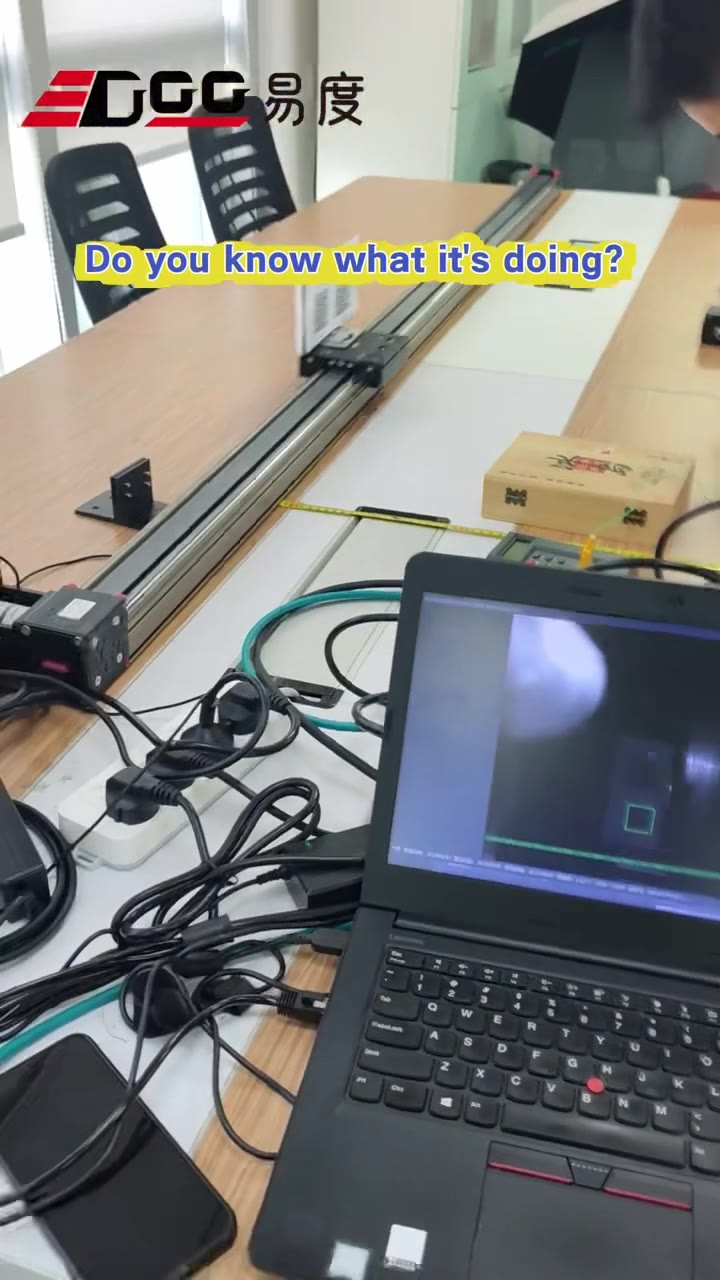
A fixed-mount reader that performs beautifully on a stationary label can miss half the parts on a conveyor, because a moving code is an exposure problem before it is a decoding problem. The clip below is the bench version of that test: an ED3009 industrial fixed-mount reader sits at the end of an aluminium linear rail while a carrier slides a printed 2D label past it, and the laptop in front of the rig shows what the reader itself sees - the located symbol boxed, and the decoded string appended on every pass. EDOO ran this test at up to 2 m/s with no missed reads.
12.6 s: a printed 2D label is driven past the ED3009 along an aluminium linear rail. The laptop carries the reader's own picture, with the located symbol boxed and the decoded strings appended as each pass is read.
Two things are worth being precise about before you use that result. First, it is a bench rig in an office, not a production line: one label type, one orientation, one standoff and a short run. Second, the number that matters to you is not the 2 m/s in the caption but the set of conditions that made it possible - field of view, exposure, symbol size and grade, illumination and the handshake that tells the host a read happened. Those are yours to reproduce, and this page is the method.
The rig is deliberately simple, because a test you cannot rebuild is not a test. A small cube-form reader is fixed on a foam block at one end of the rail; the label rides on a low carrier that is pushed along the rail, so the code enters the field of view, crosses it and leaves. A tape measure lies alongside the rail to set distance, and the reader is cabled to a laptop running the vendor tool that streams the imager picture. In the last seconds of the clip you can see the reader's own image on that screen: the label is captured while it is moving, the symbol is located and outlined, and decoded strings scroll out beneath it.
What it does not show: an ISO/IEC 15415 grade for that label, the exposure time the camera used, the exact standoff, a long production run, glossy or damaged codes, or the reject path downstream of the read. Treat the clip as the demonstration of a working point, and the rest of this page as the way to find your own.
While the shutter is open, the code moves. Image motion during one exposure is simply speed multiplied by exposure time, so at 2 m/s a 200 microsecond exposure puts 0.4 mm of smear across the sensor and a 50 microsecond exposure puts 0.1 mm. That smear has to stay small compared with the symbol's X-dimension, or the module edges merge and the decoder is reading a grey bar. A 10 mil (0.25 mm) Data Matrix module is a much tighter budget than a 20 mil one, which is why two lines running at the same speed can have completely different answers.
The second constraint is dwell time. The code is only decodable while it is inside the field of view, and the field of view at the target plane is 2 x tan(half-angle) x standoff. A symbol crossing a 60 mm field at 2 m/s is visible for 30 ms: at 30 frames per second that is roughly one frame, and one frame is one chance. Widen the field to 120 mm and you get two frames; double the frame rate and you get four. This is the arithmetic behind the "high frame rate capture" line on the sorting-gate solution page, and it is also why a longer working distance is not free - it widens the field, but it shrinks the code on the sensor.
Shortening exposure and raising frame rate both ask for more light, which is where most bench tests quietly fail and the same reader fails later on the floor. More light is not only a brighter LED: it is geometry, because a specular label or a PET carrier returns the illumination straight into the lens and erases the module edges you were trying to freeze.
| Variable | What it controls on a moving code | How to pin it down in a test |
| Line or carriage speed | Sets how long the code is inside the field of view and how far the image moves during one exposure. | Measure with a tape and a frame count, or a light gate. Do not trust the drive dial. |
| Field of view at the target plane | A wider field buys dwell time: the code stays visible longer, so more frames contain it. | 2 x tan(half-angle) x standoff. Compute it, then verify with a printed ruler. |
| Exposure time | The single biggest lever on motion smear. Shorter exposure freezes the code but needs more light. | Read it back from the camera or reader log, not from a menu label. |
| Symbol X-dimension and grade | A 5 mil mark tolerates far less smear than a 20 mil one, and a low-grade mark has less margin to lose. | Print or mark your worst real part and grade it to ISO/IEC 15415 before the test. |
| Standoff and orientation | Distance drift moves the code out of focus; rotation is usually cheap, tilt is not. | Mount on a fixed bracket and log the actual distance at both ends of the rail. |
| Illumination geometry | Bounce off glossy labels and PET carriers washes out the module edges at exactly the moment of reading. | Diffuse, off-axis, and shielded from ambient; test with the line lights on and off. |
Speed, field of view and exposure are coupled, so change one at a time and record the other two. In practice the fastest gains on a line that misses are: get closer or use a wider field so the code dwells longer, shorten exposure with more well-aimed light rather than more light, and fix the symbol itself - a slightly larger X-dimension printed on a matte surface beats any decoder tuning.
| # | Step | What "done" looks like |
| 1 | Fix the reader, move the code | Clamp the reader to a bracket at the real standoff. Put the label on a carriage that runs on a rail, a belt or a turntable, so the geometry between passes cannot drift. |
| 2 | Use your own codes | Print or mark the symbols you actually deploy, at the real size, on the real surface, in the worst grade you accept. A vendor test chart is not your part. |
| 3 | Measure the speed, do not assume it | Time the carriage over a known distance on video and count frames, or trip two sensors a metre apart. Report the number in metres per second next to the result. |
| 4 | Run 100 passes and log every one | Record first-read rate, not "it worked". Log the decoded string, the timestamp and the pass number so a miss is a row you can look at, not a memory. |
| 5 | Break it on purpose | Then vary one thing at a time: speed up past your target, tilt the label, dirty and scuff a corner, kill the ambient light and add a work lamp, and let the distance drift by a few centimetres. |
The whole rig is a bracket, a rail and a stopwatch. What makes it worth the afternoon is that it converts an argument into a number: your label, your standoff, your speed, your first-read rate. If you are buying a reader for a moving line, ask the supplier to run this test with your coupons rather than theirs, and ask for the log, not the video.
ED3009 is EDOO's industrial fixed-mount reader, and the site already describes it in one place: the intelligent sorting-system solution page installs it overhead above the sorting gate, reading the QR codes on parcel surfaces, and lists its advantages as high frame rate capture for high-speed moving lines, error-correction algorithms for damaged, distorted or low-contrast symbols, and an IP67 rating for harsh warehouse environments. That page also defines the failure path: when a parcel is not identified, the system alarms for supplementary scanning instead of stopping the line. Read it as the sorting solution write-up.
If your job is a small part on a short conveyor rather than a parcel on a gate, the same physics applies at a different scale, and the selection criteria are laid out in how to choose an industrial barcode scanner and how to choose a fixed-mount scanner module. For codes marked directly on the part rather than on a label, the DPM case is a separate optical problem and is covered with a close-range module in the miniature DPM-reading module page. Related published fixed-mount options on this site include ED3000 for fast-moving Data Matrix, the IP67 ED5000, the IP65 ED-2004-EX05 and the ED5029 industrial reader; each of those pages carries its own parameter table, and none of them should be substituted for another on the strength of a similar housing.
Is 2 m/s the limit of the reader? No - it is the speed at which this particular test passed with this label, standoff and lighting. The limit for your line is where your first-read rate falls below your acceptance number, and only your test can find it.
Why does our reader miss codes at half this speed? Usually one of three things: the code dwells too briefly in a narrow field of view, the exposure is long enough to smear the module edges, or the illumination is bouncing off the label face. All three are measurable in an afternoon on a bench rig.
Does a higher frame rate fix a moving-code problem? It helps the odds, because more frames contain the symbol. It does not fix smear inside each frame, which is an exposure and light question, so raise frame rate and light together.
Can it read damaged or low-contrast codes? The published sorting-solution description credits ED3009 with error-correction for damaged, distorted and low-contrast symbols. Verify that on your own worst real part, because "damaged" spans a wide range and the margin depends on the X-dimension you print.
What about a curved or shiny part? Put the code on the flattest face you can, keep the label matte, and light off-axis. If the part itself must carry the mark, that is a direct-part-mark job and needs DPM coupons in the test.
Do I need a trigger sensor? On a continuous rail, no; on a line where parts arrive irregularly, yes - and then the trigger-to-read latency becomes part of the acceptance test, because a late trigger means the code is already leaving the field.
Send us a few of your real labels or parts, the line speed in metres per second, the working distance you can give the reader and what the line does on a no-read today. With those four numbers a bench run of this test becomes a pass-rate figure rather than a promise - how to request a sample reader or scan engine explains what we need from you and what we send back. The parameter tables for the published fixed-mount models are on their product pages, and the general selection criteria are in the industrial scanner buying guide.
About

Products
Solutions
Support
News